
How physics, physiology, and Islamic practice align to restore coherence in a noisy age
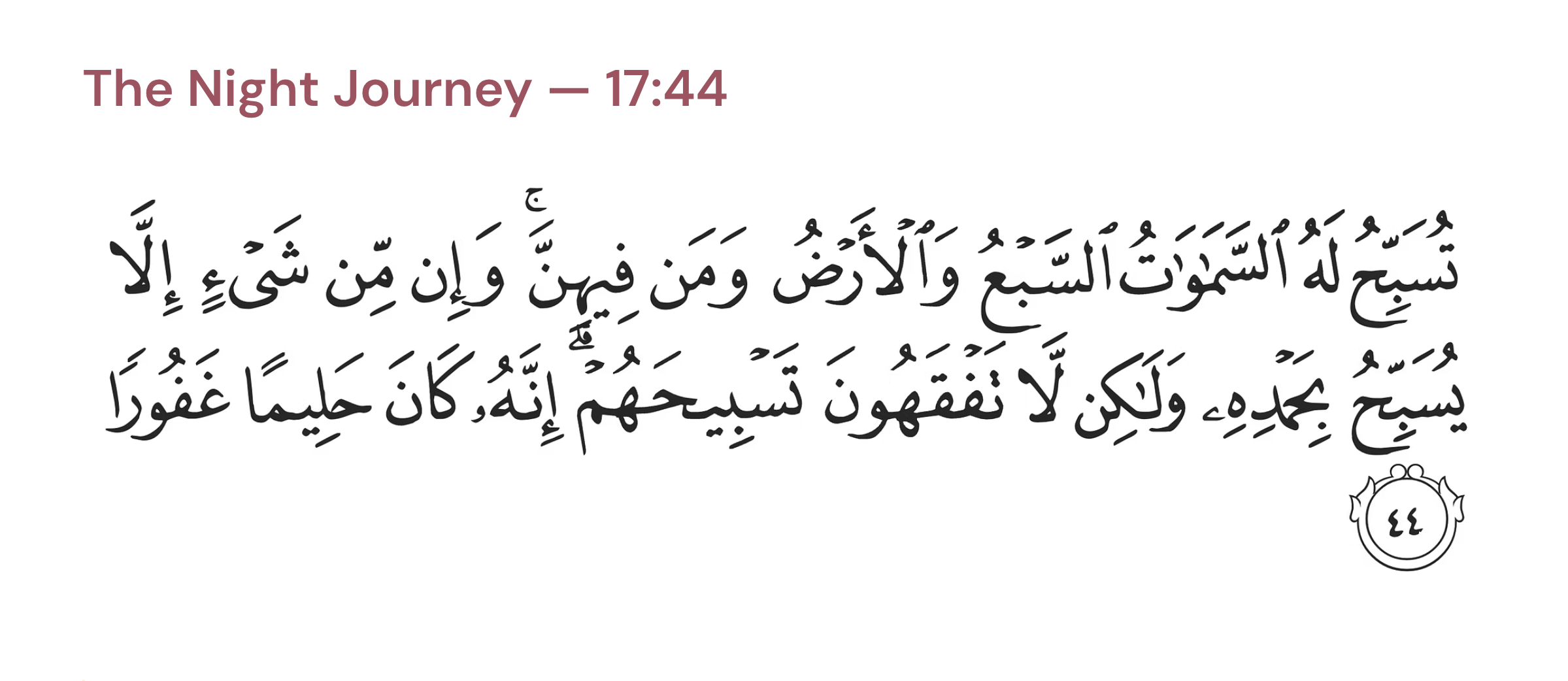
“The seven heavens, the earth, and all those in them glorify Him. There is not a single thing that does not glorify His praises but you cannot comprehend their glorification.” Qur’an 17:44
If the universe could speak, it wouldn’t speak in sentences, it would breathe in rhythm and exhale in vibration. Sound is not entertainment; sound is architecture. It builds emotion, instructs physiology, and when offered with intention awakens belief. This essay distills a talk I’ve delivered across communities and conferences, mapping the journey from physics to prayer and back again: how vibration becomes meaning, how meaning becomes behavior, and why Islam’s sonic practices were built as systems of coherence.
Why sound matters (to your day, your team, your city)
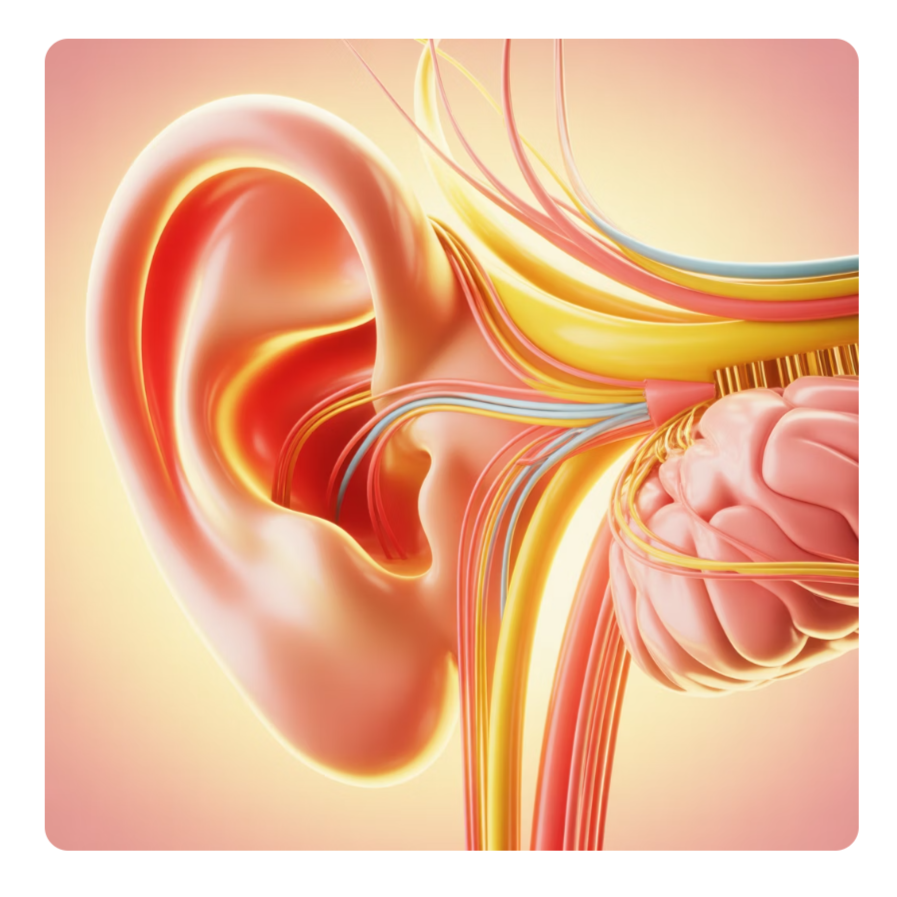
Sound reaches you faster than thought. The pathway is ancient and efficient:
ear → brainstem → limbic system → autonomic nervous system.
Before your cortex drafts a paragraph, your body has already decided whether to lean in or brace. That’s why the right gym track quickens your pace, a lullaby softens breath, and a measured recitation of Qur’an draws the chest into ease. The sonic diet we keep tempo, tone, timbre quietly shapes our patience, our focus, and how we treat one another.
Emotion lives in a space, not a line
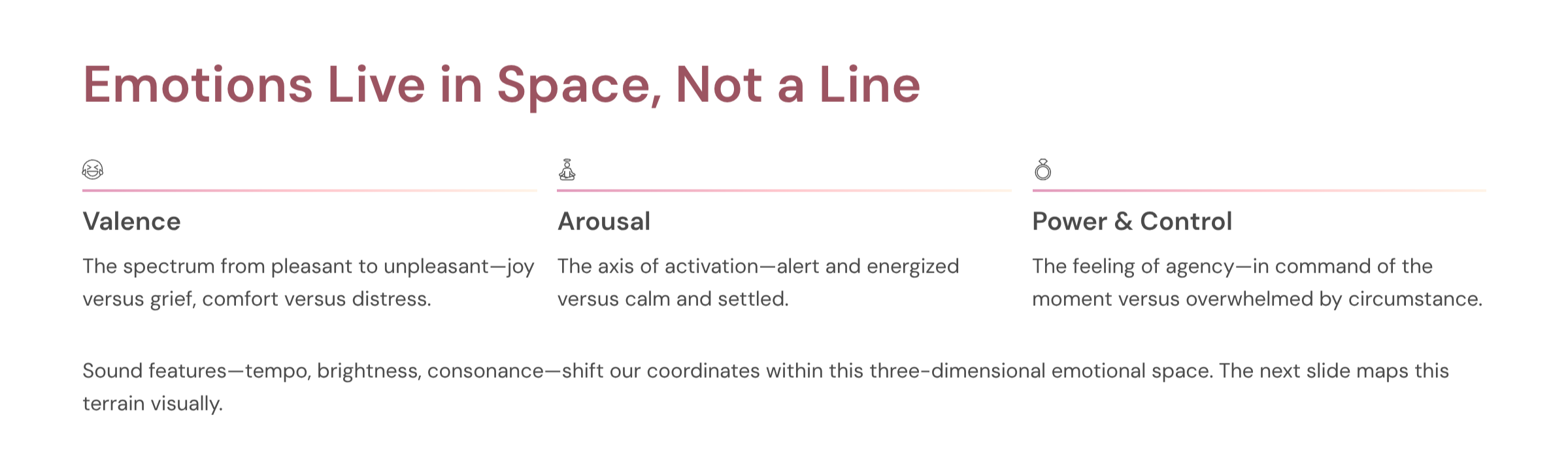
In the valence–arousal–power model (often called the circumplex), feelings occupy a map rather than a single scale.
Valence runs pleasant ↔ unpleasant
Arousal runs calm ↔ activated
Power/control tilts low↔high.
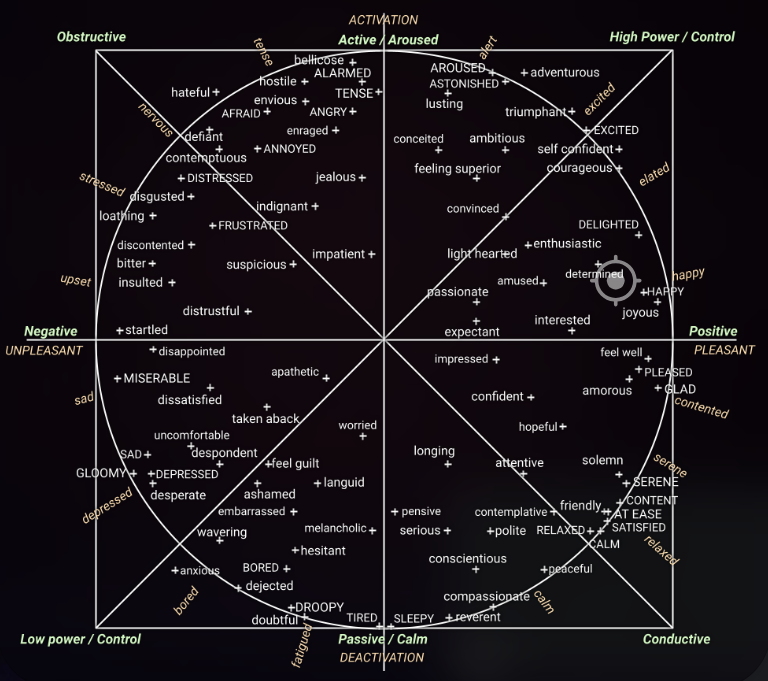
The Emotion Circumplex
Audio features move us across that map:
Tempo & pulse clarity: faster, clearer beats tend to push us “up and right” toward energized, pleasant states; slower, blurrier rhythms invite reflection or calm.
Spectral brightness & roughness: brighter, harsher textures elevate alertness and tension; darker, smoother tones invite warmth or solemnity.
Harmony/mode: major/minor colors emotion, but context and memory can override the rule.
On stage, I show this with the Emotion Circumplex and a short prosody exercise: one neutral sentence, two different cadences, same words, different feeling. We design with tendencies, not absolutes. Context, task, intention, and meaning always matter.
When Sand Finds Stillness
When vibration draws geometry (and what it does not prove)
The Chladni plate remains one of the most elegant demonstrations of resonance. Scatter sand on a thin metal plate; sweep through frequencies; watch patterns “snap” into being as sand gathers on nodes of standing waves. It is breathtaking and it is physics. Cymatics reveals how frequency + boundary conditions yield order, but it does not demonstrate that specific words carve unique shapes in matter. I use this as a metaphor for how structure emerges from sound, not as a laboratory claim.
Arabic as felt meaning; tajwīd as sound ethics


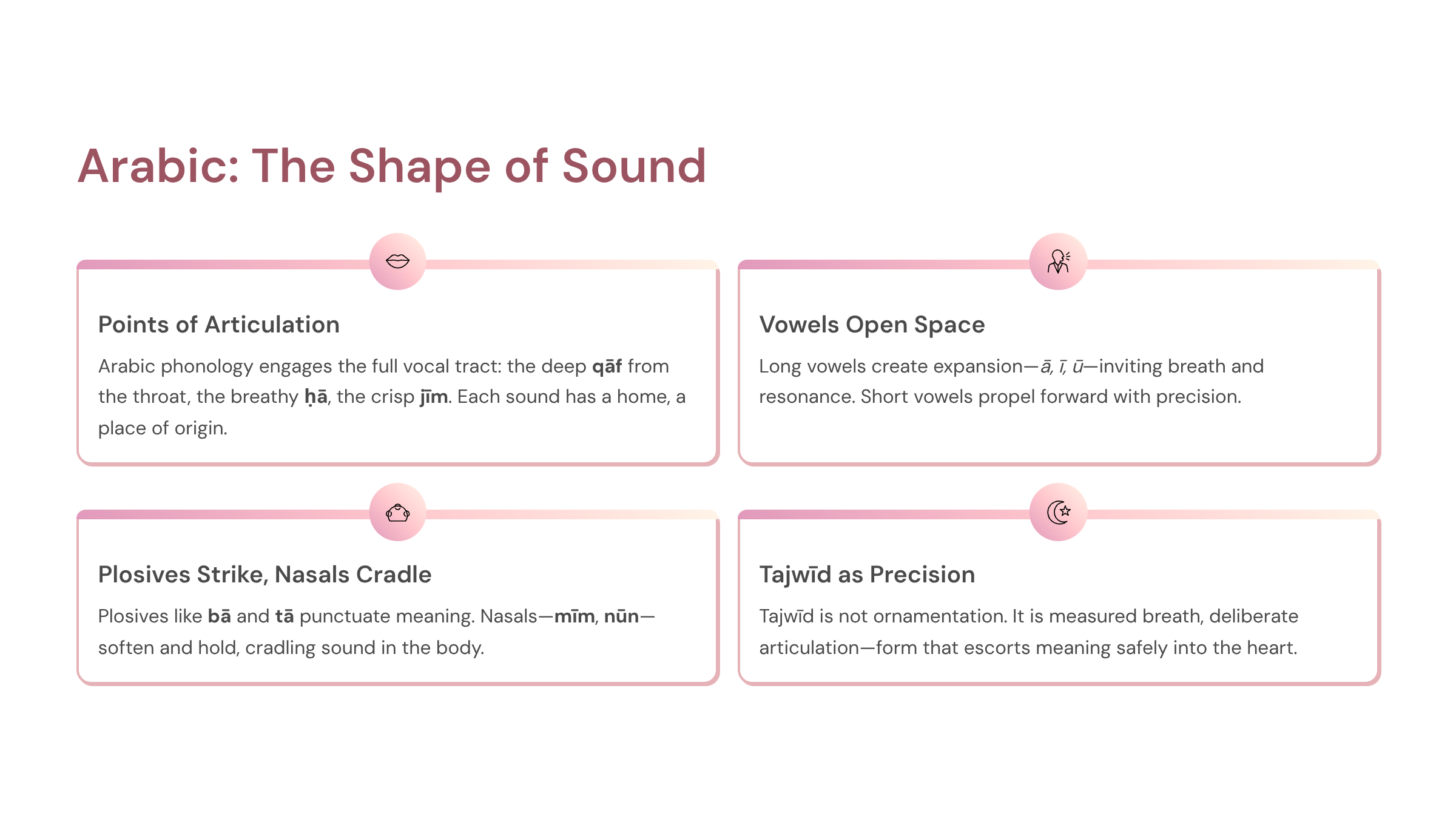
Arabic isn’t only understood; it’s felt. Plosives can strike; open vowels cradle; mellifluous consonants flow. Try whispering Jahannam (tight, harsh) and Jannah (open, spacious) and notice what happens in your jaw and chest. Tajwīd is not ornament, it is precision engineering for the voice: measured breath, deliberate articulation, controlled dynamics and melodic contour that escort meaning safely into the heart. In Sufi practice this becomes samāʿ listening as worship, where attention and adab tune the self to receive.
Coherence vs. complexity:
what your body sees and hears
A simple scope visualization makes this intuitive. On a goniometer, a sine wave draws a near-perfect circle. Conversational speech splinters that circle into jagged complexity. Measured recitation appears as intricate yet organized flow still complex, but patterned. This isn’t a diagnostic device; it’s a picture of what we feel: when breath steadies and cadence is intentional, perception steadies too
The principle of resonance:
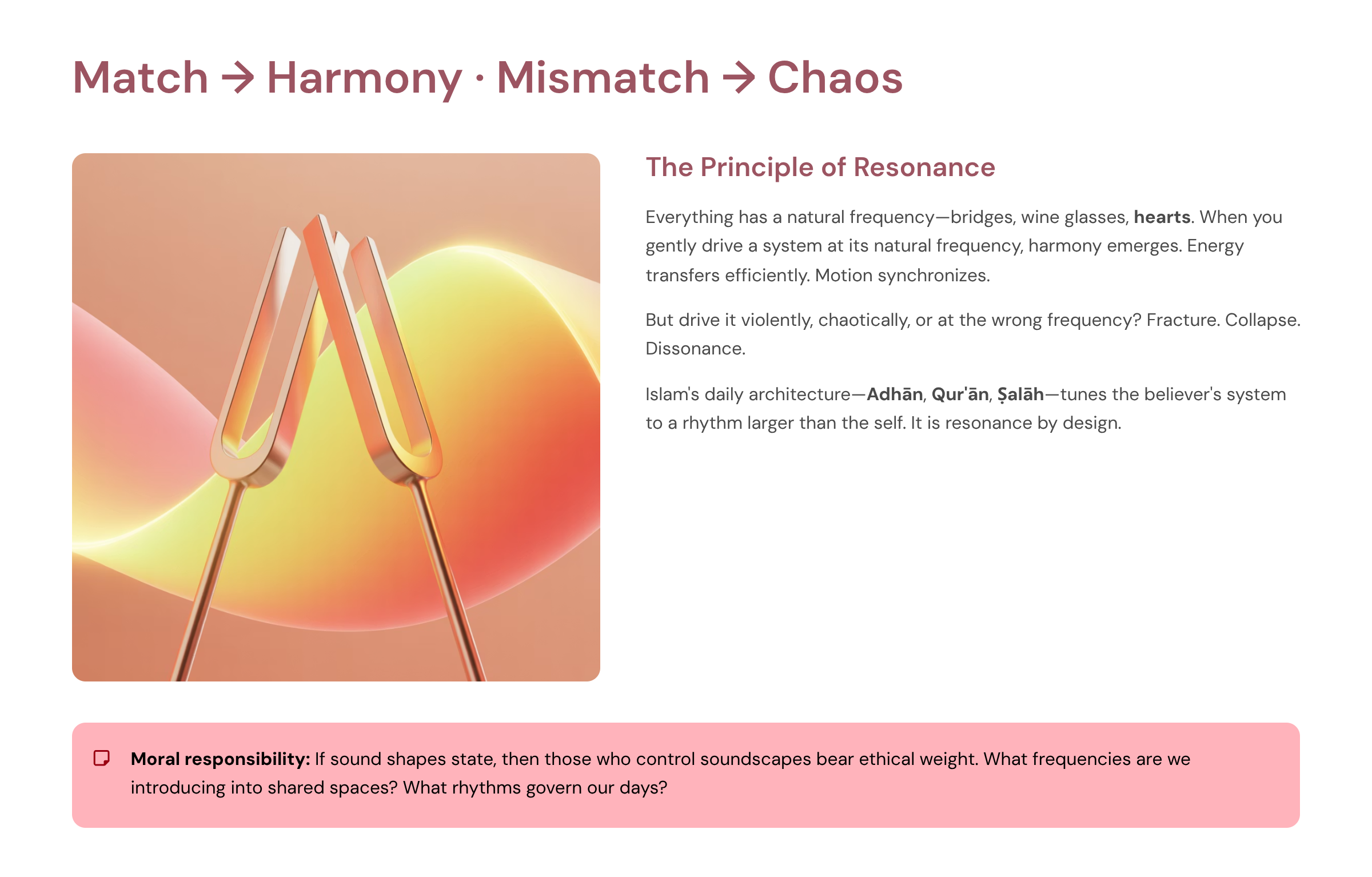
match → harmony; mismatch → chaos
Everything has a natural frequency bridges, glasses, hearts. Drive a system gently at that frequency and energy transfers efficiently; harmony blooms. Drive it violently or wrong, and systems fracture. Weaponized sound exists; so does therapeutic sound. The ethical question is: what frequencies are we introducing into shared spaces? Islam’s daily architecture answers with design: Adhān to orient, Qur’ān to steady, Ṣalāh to align, Dhikr to sustain.
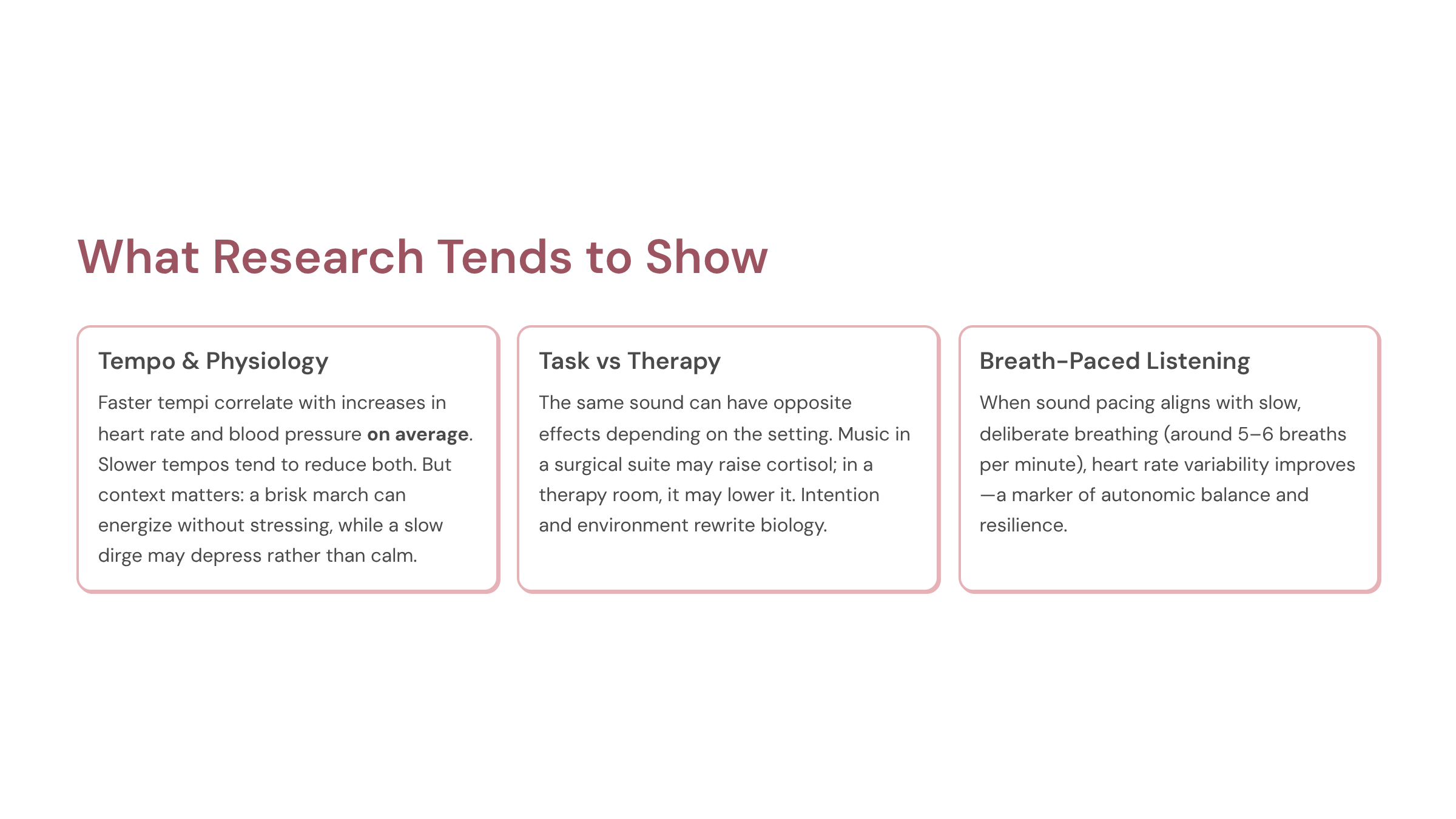
Across many studies, faster tempi tend to increase heart rate and blood pressure on average; slower tempi tend to reduce arousal. But context flips direction: the same track that elevates cortisol in a stimulating task can soothe in a therapeutic one. Aligning sound with slow, deliberate breathing (about 6 breaths/min) can improve heart-rate variability (HRV) a marker of autonomic balance and resilience. These are probabilities, not pronouncements; person × task × intention × meaning rewrite results.
In clinical and community settings, Qur’ān listening/recitation often trends toward reduced anxiety and heart rate with improved calm and HRV. I phrase this as converging tendencies rather than guarantees, honoring both the literature and each person’s experience.
From our live sessions, this brief protocol consistently helps attendees feel the science in their own bodies:
Breathe 4–6: Inhale through the nose for a gentle count of 4, exhale through the mouth for 6.
Repeat for ~6 cycles (≈ 40–60 seconds).
Keep shoulders easy, jaw soft, gaze gentle. Use it before challenging conversations, after conflict, or as preparation for prayer. Many notice a subtle drop in heart rate and a shift toward steadier attention.
A micro-practice to try today:
The Resonance Reset
The Islamic soundscape: rhythm as rehabilitation
Our tradition has always treated sound as formative, not decorative:
When the Prophet ﷺ entered Madinah, the community welcomed him with “Ṭalaʿ al-Badru ʿAlaynā.” Whether in narrow streets or open courtyards, the effect was the same: a city knit into one heart through shared sound. That is still our path. We shape the worlds we live in by the sounds we choose to live with.

Adhān stretches the vowels and invites longer exhalation, nudging the nervous system toward safety.

Qur’ān recitation couples meaning to measured melody, calming the limbic system while training attention.

Ṣalāh synchronizes breath and posture, standing, bowing, prostrating, sending steady signals to the insula and anterior cingulate that the body is held.

Dhikr repeats until rhythm becomes refuge, the heartbeat turning into remembrance.
For leaders & builders: curate the acoustic environment
If sound steers state, then the people who curate soundscapes, event producers, educators, product designers, spiritual leaders bear ethical weight. Consider: What frequencies fill your foyers and feeds? Where is silence honored? How does your cadence (emails, meetings, push notifications) entrain behavior toward scatter or toward focus? A culture’s audio hygiene is as real as its cybersecurity policy.
The takeaway (and the way forward)
Sound is not an ornament of life; it is the engine of it. The Qur’ān, the Adhān, and the rhythms of Islamic living are divine systems of resonance that realign the human mind, body, and soul with the natural order of creation. Through science, we are learning to see what revelation always knew peace is not an emotion; it is a frequency.
Try this for seven days: begin your morning with the Resonance Reset, follow with 5–7 minutes of Qur’ān listening/recitation, and carry a quiet dhikr through your commute. Note your breath, your patience, your posture. Then ask: What would change if our homes and organizations lived at this cadence?
Adhān to orient. Qur’ān to steady. Ṣalāh to align. Dhikr to sustain. May our breath, our pulse, and our choices enter the praise already happening everywhere.